1. The High Aspect Ratio Efficiency Mandate
In subsonic commercial flight, induced drag accounts for up to 40% of the total aerodynamic resistance experienced by an aircraft at high cruise altitudes. Induced drag is inversely proportional to the wing aspect ratio (AR = b² / S, where b is wingspan and S is wing area). To radically minimize induced drag without adding parasitic drag, Boeing engineers expanded the wingspan of the 777X to an unprecedented 71.75 meters (235 feet 5 inches), providing an aspect ratio exceeding 10:1.
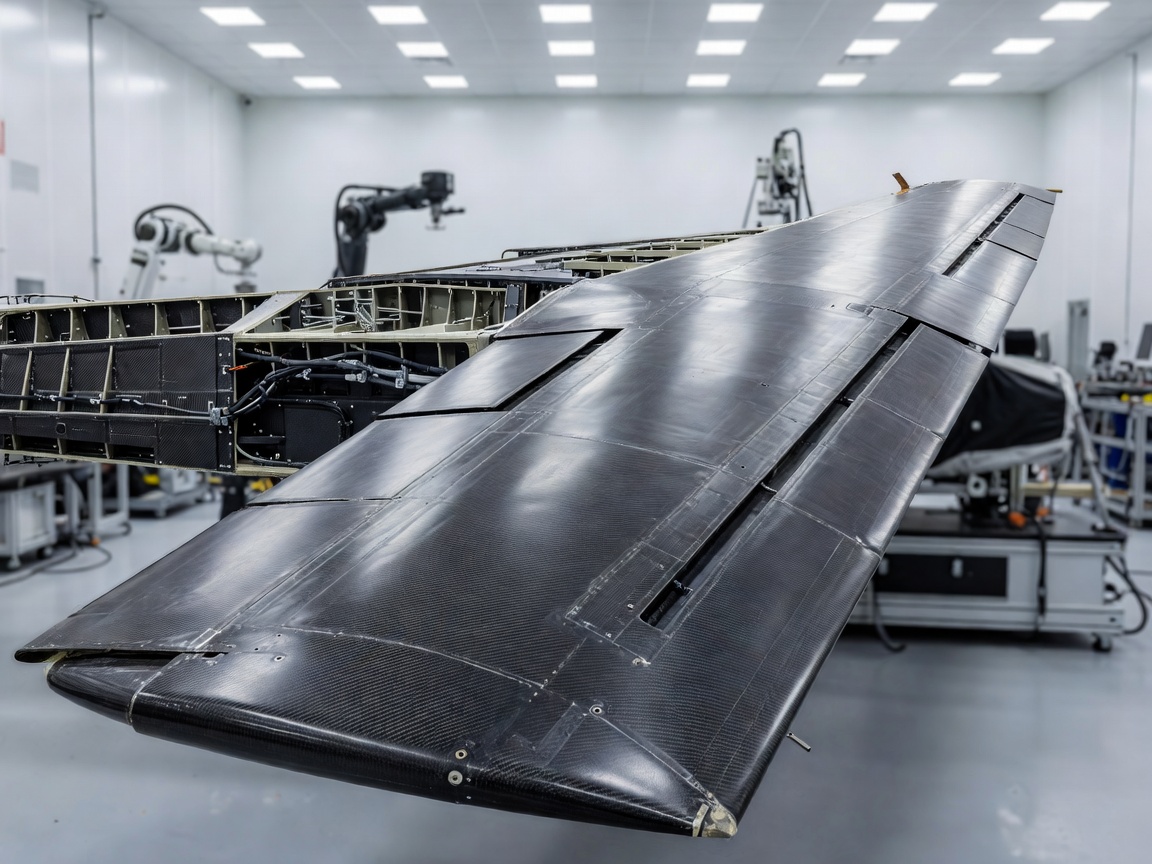
Manufactured at the Composite Wing Center (CWC) in Everett, Washington, the 777X wing skin and spars are fabricated from automated fiber-placed carbon-fiber reinforced polymer (CFRP). Cured in giant autoclaves, the monolithic composite wing avoids the weight penalties and structural fatigue joints inherent to traditional multi-panel aluminum construction. The high flexibility of the wing enables a natural aeroelastic tailoring: under flight aerodynamic loads, the wingtip naturally twists to wash out angle of attack at the tip, mitigating root bending moments.
2. Gate Compatibility: The Code E vs Code F Dilemma
While a 71.8-meter wingspan is aerodynamically optimal in flight, it creates severe logistical hurdles on the ground. International Civil Aviation Organization (ICAO) and FAA aerodrome regulations classify aircraft wingspans into distinct categories:
- ICAO Code E: Wingspans from 52 meters up to, but not including, 65 meters (e.g., Boeing 777-300ER, Airbus A350-900/1000).
- ICAO Code F: Wingspans from 65 meters up to 80 meters (e.g., Airbus A380-800, Boeing 747-8).
Code F aircraft face restricted routing at worldwide airports, requiring wider taxiways, larger gate separations, and modified parking boxes. To ensure the 777X could operate seamlessly at the thousands of existing Code E airport gates around the globe, Boeing created a 3.5-meter (11-foot) folding wingtip on each side. When folded vertically on the ground, the wingspan contracts to exactly 64.82 meters, comfortably within Code E operational limits.
Hinge Cycle & Transition Specifications
Fold Cycle Duration: Approximately 20 seconds for full deployment or stowage.
Folded Angle: 90 degrees vertical rotation relative to the wing plane.
Activation Point: Automatically unfolds during pre-takeoff taxi when passing ground speed gates; auto-folds immediately upon landing rollout when ground speed decelerates below 50 knots.
3. Electromechanical Locking & Actuation Mechanism
The folding wingtip mechanism was developed in partnership with Liebherr-Aerospace. The system consists of a primary electric motor power drive unit (PDU), rotary actuator hinges, and a redundant mechanical pin-locking mechanism. Because the wingtips carry active aerodynamic control surfaces (outboard raked extensions and position lights), structural integrity during flight is critical to safety of flight.
The mechanism relies on multiple physical primary locking pins that translate horizontally through interlocking structural lugs once the wingtip is fully seated in the horizontal position. Independent latch sensors verify mechanical engagement. The flight control computer (FCC) prevents takeoff thrust application if any pin position transducer reports an unlocked or transit state. In flight, hydraulic and aerodynamic loads cannot unlock the mechanism due to mechanical over-center geometry and fail-safe locking dogs.
4. Flight Crew Interface and Certification Standards
To eliminate flight crew workload during critical high-speed taxi and rollout phases, the wingtips are integrated into the autoflight avionics logic. On the flight deck overhead console, a rotary switch allows manual override ("FOLD" or "EXTEND"), but standard operational protocols rely entirely on automated sequence control:
- Taxi-Out: Upon entering the active taxiway and completing the before-takeoff checklist, the crew arms the system or the FCC detects runway approach, smoothly rotating the tips down into the locked cruise geometry.
- Taxi-In: Once wheels are down and the 777X decelerates past 50 knots on the landing rollout, the sensors command tip unlock and vertical folding, eliminating the risk of ground gate collisions as the aircraft transitions off the high-speed turnoff.
The FAA issued special conditions (14 CFR Part 25) governing the certification of folding wingtips, ensuring identical structural margins to non-folding wing roots against aeroelastic flutter, gust response, and lightning strikes.