1. Cabin Pressurization and Humidity Optimization
Conventional commercial aluminum airframes have historically operated with cabin altitudes maintained at 8,000 feet (2,438 meters) during standard cruise flight at 35,000 to 41,000 feet. This represents an atmospheric differential pressure of approximately 8.6 psi (59.3 kPa). High cabin altitudes lower oxygen partial pressure in the blood, accelerating passenger dehydration, travel fatigue, and headaches.
Drawing directly from structural load transfer techniques developed on the 787 Dreamliner, the 777X incorporates reinforced window frames, skin stringers, and pressure bulkheads engineered to support a continuous cabin altitude of 6,000 feet (1,828 meters) at a typical cruise altitude of 41,000 feet. This 2,000-foot drop in cabin altitude delivers a 9.5 psi differential pressure, maintaining higher alveolar oxygen saturation for passengers across 14-to-18-hour long-haul flights.
Additionally, advanced gaseous air filtration and active humidification systems permit relative humidity levels up to 16-20%, double that of older widebodies, without risking condensation accumulation behind the insulation blankets.
2. Sculpted Sidewalls and Usable Cabin Width
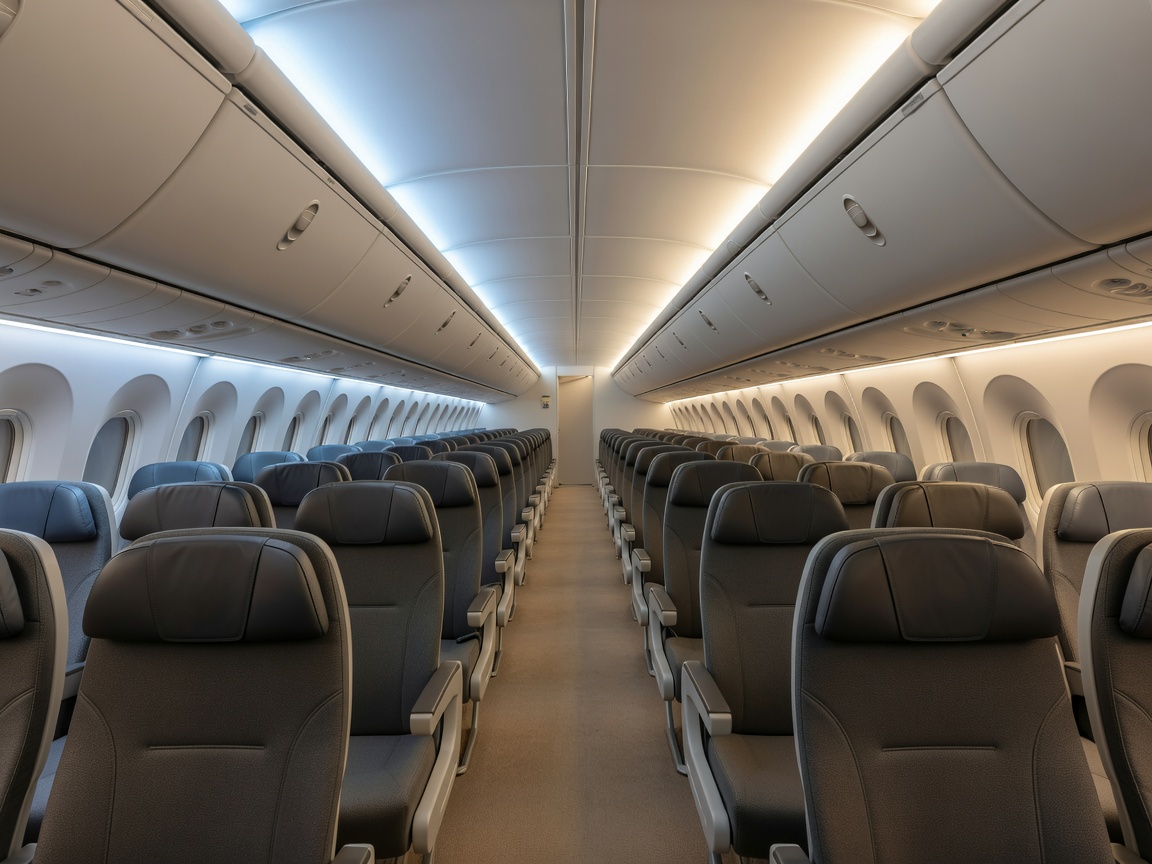
The exterior fuselage diameter of the 777X remains 6.20 meters (20 feet 4 inches), matching the classic 777. However, Boeing engineers re-engineered the interior framing, insulation packs, and molded cabin sidewalls to carve out an extra 10.2 centimeters (4.0 inches) of interior usable width, bringing total cabin width to 5.96 meters (19 feet 7 inches).
Dimensional Impact on 10-Abreast Seating
Legacy 777-300ER (10-Abreast): 17.0 to 17.2 inch cushion width, narrower aisles.
Boeing 777X (10-Abreast): Full 18.0 inch (45.7 cm) seat width across all economy seating positions, coupled with standard aisle clearances.
Overhead Stowage: Redesigned bin linkages allow 100% of passengers to stow a regulation roll-aboard suitcase overhead while reducing bin closure lift force by 40%.
3. Electrochromic Window Systems
The 777X introduces the largest passenger windows in the commercial widebody category, measuring over 162 square inches (1,045 cm²) each. Positioned higher on the fuselage wall than those on the 777-300ER, they align more naturally with human seated eye lines, giving passengers across the cabin an unobstructed view of the horizon.
The windows abandon mechanical pull-down plastic blinds in favor of Gentex electrochromic dimming technology. The glass panel incorporates an electrochromic gel layer sandwiched between conductive transparent coatings. By modulating electric current via passenger touchpad switches or central flight attendant panels, the opacity transitions smoothly from fully transparent to an ultra-dark tint blocking 99.9% of visible light, all while preserving the outside horizon view.
4. Acoustic Attenuation and Lighting Integration
Acoustic performance inside the cabin has been significantly refined through advanced CFD noise path mapping. The General Electric GE9X engines utilize one-piece acoustic composite fan cowls and Chevron-optimized nozzles that attenuate low-frequency jet mixing noise. Inside the cabin walls, targeted acoustic insulation blankets isolate the cabin from aerodynamic boundary-layer turbulent noise generated at Mach 0.84.
The lighting infrastructure consists entirely of programmable full-spectrum LED fixtures. The cabin management system (CMS) can dynamically recreate circadian daylight curves, smoothly shifting color temperature and lux intensity to mimic natural sunrise and sunset transitions across time zones, minimizing jet lag on ultra-long-range missions.